REACHING GEN Z
Discipling the New Generation of Students
Meeting new people can be exciting, interesting, intriguing, perhaps even perplexing. Whatever your first impressions, if you want any kind of relationship to develop, you’ll need to converse, listen, engage.

Earlier this year, we met Gen Z. It was Peter Dray who made the introduction, when he shared with us four standout characteristics that he’d observed across today’s global student generation.
But what next?
How can we further engage?
This month, his initial observations will be expounded through the publication of a Gen Z Insights report, with accompanying Bible studies and podcasts.
A conversation has begun. And other IFES voices are chiming in.
Thanks to the work of an IFES Task Force called “Discipling a New Generation of Students”, you’ll hear more in 2026 about how you can listen to and engage with this distinctive cohort. “We want to see a generation of staff who are aware, sensitive, and able to reach out and disciple a new generation of students that are encountering and following Jesus in their contextual reality,” says the Task Force in their vision statement. For, even though campus staff are meeting Gen Z every day, many feel the need to deepen their understanding of this younger demographic and their situation.
In this Conexión blog, we talk to the co-chairs of the Task Force – Alejandra Ortiz (AO) and Lisman Komaladi (LK). They tell us what’s been achieved and what we can look forward to in the coming year.
How did this Task Force come about and why did you get involved?
LK: Back in early 2024, Annette Arulrajah approached us. Part of her mandate as IFES Associate General Secretary is to help the Fellowship disciple a new generation of students.
I’d been talking to her about how our national movements had responded in IFES surveys over recent years. I’d noticed that a top five priority for many was reaching and discipling the new student generation. And that was true for movements in East Asia [where Lisman is Regional Secretary].
At that time, I think I spoke to Annette and said, “What’s IFES planning to do about it?”. And then – maybe because of that! – she asked me to help co-lead the Task Force.
AO: When Annette invited me, I thought, “yes, this is definitely something I want to participate in!”.
That’s because I noticed something at the student gathering at the last IFES World Assembly. As it was basically student-led, a lot of what they brought, and what they wanted to discuss came into play.
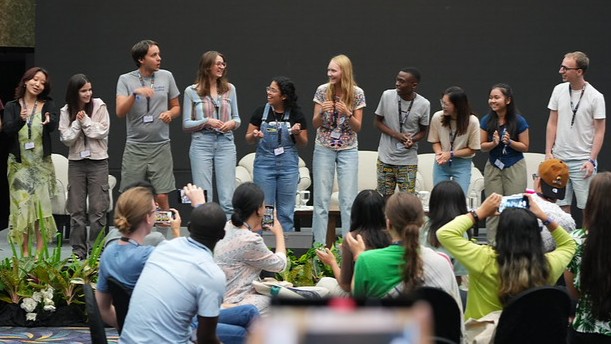
And I was just fascinated by how these students were bringing their questions and desiring a space to approach those issues – things that, if we’re staff or from a different generation, we’re often nervous to talk about! They were talking about sexual issues. They were talking about politics. They were talking about climate change. And they were talking about all these things just like they’d discuss them with their peers at university.
Some of them were saying, “I can’t bring this stuff up with staff in my movement.” They felt their staff workers lacked good responses or the capacity to respond. But, at that gathering, the students were hearing each other out, sharing their experiences of following Jesus in their contexts.
They’re wanting to love their friends. They’re wanting to connect. They were refining their questions and then bringing them to others, to older senior staff. And I thought, there’s a huge gap here!”
So, how have you approached identifying and bridging this gap?
LK: We reached out to key people in all 11 IFES regions and ended up with a Task Force of 11 people from eight regions.
AO: Most are staff or general secretaries who work directly with Gen Z and a couple of them are actually Gen Zers.
LK: From May 2024 to July 2025, we met online every two or three months.
AO: One of the first things we did together was develop a process so that we’d make the most out of the meetings – especially because we were a group with so many different people from different contexts.
LK: We came up with three phases of a process – a listening journey, a learning journey, and a dreaming journey.
In the listening journey we heard stories from the nine regions. Then we said, “okay, having heard these different points, what can we learn?”. And we divided the learning journey into three tracks: a theological and biblical framework, pedagogical principles, and practical ideas and best practices.

AO: Something key about the listening journey was that we encouraged each person to bring a question. Once they’d presented their context and how discipleship was working, they presented their question – something out of curiosity that would help us further understand their observations.

That’s actually what led us to those three tracks – because we saw that we were trying to answer three types of questions: those that were more to do with the theological basis for discipleship, those that were around the pedagogical approach to discipleship, and others that were related to practice.
LK: So, we had two or three research questions for each track which we explored in each of those three groups.
And the third phase is the dreaming journey. We summarised and presented all our findings and learnings and started generating ideas for how to respond. Right now, Alejandra and I are finalising a five-page executive summary with recommendations which we’ll soon present to the IFES core leadership team.
Can you share what your listening and learning revealed?
AO: One of our early discoveries confirmed what I’d felt at World Assembly – and it came from everyone who was sharing. It was the need to pay attention to staff workers. We’d set out to discuss the students and this new generation in the gap, but we soon realised that we needed to focus more on those who are actually working with the students to support their formation.

So, our recommendations and dreaming journey aren’t directed at the students but at the staff of national movements and IFES ministries. Because that’s where the gap is. And that makes our resources a little different. Something like the Gen Z Insights report is great for a wide audience to think about the issues, but our work offers a framework specifically for those ministering to Gen Z students.
That said, we did try to give an overall panorama of what we’d heard – and we noticed that there were very similar issues across our different regions. Things such as seismic changes in the way university education is done. Or the growing fragmentation and polarisation in culture and society. Or Gen Z’s digital hyper-connectivity, which is often accompanied by loneliness and fatigue. Or the shifting expectations of this generation around things like authority, mental health, and authenticity.
LK: But we should stress that we also saw how a lot of this is so contextual – it needs to be figured out in the local setting. Of course, there are global trends. And we could develop some resources around those, but our strongest call is for IFES movements to spend time in observation and self-reflection – to take their own listening journeys.
In fact, we’ve tried to make sure that the Task Force worked throughout with a posture of honouring the different voices we were listening to. So, rather than us saying “here’s what we suggest”, with a one-size-fits-all approach, we want to encourage movements to consider how they can pay attention to staff formation. We can offer tools and resources to help them assess how their approach to discipleship might need to shift to better connect with their Gen Z students.
What theological themes emerged for you around this shift?
AO: We were thinking about what it means to do incarnational ministry in a way that’s committed to witnessing to Christ in the context of the university. And something that’s not new to IFES: whole-life discipleship. We wondered how we can thicken that concept.
LK: Yeah, a discipleship that’s not only about imparting knowledge but also about addressing every aspect of life. And to involve all the senses! Of course, we are a ministry of the mind, but actually it’s about all of life, especially for the current generation of students.
AO: And as we were thinking about hyper-connected students around the world, we thought about what I think John Stott calls “globally minded disciples” – those who follow Jesus with an understanding of the global church.
Something else I’d mention – and these aren’t theological concepts per se – are journeying together with students, which has to do with mentoring and also vulnerability. This generation invites us to more fully explore what it means to mentor disciples, especially because of its desire for authenticity and integration.
For example, what does it mean to journey alongside students who are more aware of their limitations, who are seeking their own mental health and well-being?
You know, something we hear a lot from staff is “oh, this generation isn’t willing to commit.” But what if they’re not willing because they’re trying to guard themselves? What does it mean to recognize that there’s something good in their desire for a balanced life?

So, it’s also about how our interactions with Gen Z challenge our own journeys so that we’re more able to accompany them. And I think that’s something about the discipleship relationship that hasn’t really been highlighted previously. In this generation, that kind of openness and vulnerability is one of the first things they’re looking for – they want to know what you’re made of!
What can we look forward to in coming months?
LK: We’re in the process of writing up all our findings into a five-page summary, which includes some recommendations. That will be reviewed by the IFES leadership.
AO: We’re hopeful that the recommendations will stir more dialogue about the best next steps to serving the new generation. Of course, our journey has given us ideas for ways forward. But we realize that we’re inviting a process of reflection and communal work, not developing a new program.
LK: But, for example, one practical outcome could be to appoint ambassadors to communicate the Task Force’s recommendations. It may also be appropriate to publish monographs and resources connected with the Task Force’s journey – that might be podcasts, video clips, training modules or even board games – anything that can help national movements start their own journeys.

On IFES channels, we could create ways to share indigenous stories – we hope that every national movement will take part in a reflective process and then share what they discover. The Task Force, or the proposed ambassadors, can help facilitate that process. But every movement needs to discover their own stories, insights, and inspirations – those are gifts that can be shared with the whole fellowship to foster our mutual learning.
AO: For those of us who’ve been through the process, I think we’d say its strength was in how we’ve been shaped. Listening to the different realities of our colleagues around the world – the challenges and the things that were unique and the things we held in common – that conversation has shaped how we now think about discipleship or student events. For me, even World Assembly 2027 planning is being informed by what we’ve learned [Alejandra is Program Director for IFES World Assembly 2027].
Ultimately, it’s setting up these kinds of conversations that will be one of the main things we can offer.
Time to Develop the Relationship
In the meantime, Lisman and Alejandra commend to us all other work that’s been happening across IFES – especially the Gen Z Insights report and the Gen Z discussions among French-speaking movements.
First impressions have been made.
Now it’s time to go deeper, to converse, listen, and engage. Are you ready to reach – and walk alongside – this new generation of students?


GEN Z INSIGHTS
Visit a new web page that hosts the full Gen Z Insights report. Discover podcasts and Bible studies connected with the report as well as links to other resources.
GEN Z CONVERSATIONS
Non-French speakers can choose autogenerated subtitles

LEARN MORE ABOUT MINISTRY AMONG GEN Z
A generation of worried and curious students is finding joy! Discover how IFES movements are offering good news to the curious and sharing good news with the worried.

SHOW YOUR SUPPORT FOR GEN Z
Will you ensure the good news of Jesus reaches a new generation?
Deep peace for worried souls.
True connectedness for digital natives.
Abundant life for spiritual seekers.
Today, express your heart for Gen Z students with a gift – and help them thrive in Christ.